 Welcome to the United Nations
Publications
Displaying 1 - 6 of 6

UN General Assembly Reports on Social Development |
As part of the preparations for and observance of the thirtieth anniversary of the International Year of the Family, the report is focused on the impact of climate change on the well-being of families, highlighting challenges relating to food and water scarcity, worsening physical and mental health, increased intrafamilial violence and child marriage. In the report, the Secretary-General focuses on the role of families in climate action, as food producers, educators, consumers and advocates, and elaborates on policy implications, including under updated nationally determined contributions. He also highlights good practices in family policymaking at the national and regional levels and…

UN General Assembly Reports on Social Development |
The report contains recommendations of concrete measures to advance the long-standing social commitments established in the Copenhagen Declaration on Social Development of 1995 and the Programme of Action of the World Summit for Social Development. Member States are called upon to: (a) close persistent gaps in access to essential services; (b) improve the quality of services; (c) invest in productive employment and decent work; (d) establish fair, effective and efficient tax systems; (e) promote transparent, inclusive and accountable governance; and (f) strengthen multilateral cooperation rooted in equity, economic security and solidarity.

UN General Assembly Reports on Social Development |
The report contains an exploration of the central role of social capital as a transformative strategy for addressing multidimensional poverty and strengthening inclusive societies. Recognizing that poverty is both economic and relational in nature, the report serves to highlight how investments in trust, participation and social networks can reduce structural barriers, expand opportunities and foster a shared sense of belonging. In the report, national experiences are used to illustrate how social capital can be mobilized across key sectors, including employment, education, health, housing and community development, to address multidimensional poverty. The importance of inclusive…

UN ECOSOC Reports on Social Development |
As part of the preparations for and observance of the thirtieth anniversary of the International Year of the Family, the report is focused on the impact of climate change on the well-being of families, highlighting challenges relating to food and water scarcity, worsening physical and mental health, increased intrafamilial violence and child marriage.In the report, the Secretary-General focuses on the role of families in climate action, as food producers, educators, consumers and advocates, and elaborates on policy implications, including under updated nationally determined contributions. He also highlights good practices in family policymaking at the national and regional levels and…
Policy Briefs |
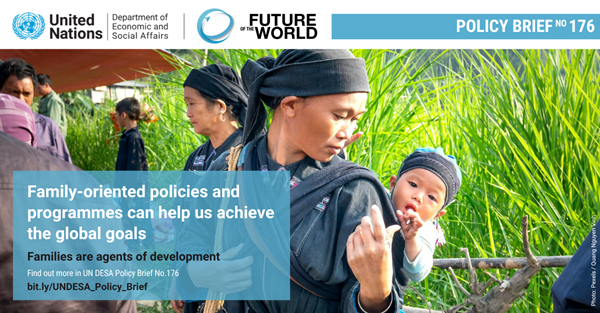
This policy brief presents a global analysis of 171 Voluntary National Reviews (2020–2024) from 141 countries addressing core aspects of family well-being by focusing on policies related to: poverty reduction (SDG1), food security and nutrition (SDG2), health and well-being (SDG3), quality education (SDG4), and gender equality (SDG5). These VNRs demonstrate little and uneven progress in implementing family-oriented policies, compared to the 2016–2019 VNRs. There is modest positive progress in reducing poverty, improving maternal and child mortality, and increasing access to water and sanitation services. However, family-oriented policies addressing extreme poverty and food insecurity have…
Publication |
The 2025 VNR Synthesis Report prepared by UN DESA’s Division for Inclusive Social Development examines how family-oriented policies have contributed to the implementation of the Sustainable Development Goals (SDGs), based on 171 Voluntary National Reviews submitted by 141 countries between 2020 and 2024. It adopts a multidimensional analytical framework that integrates socioecological models, welfare regimes, redistributive approaches, social investment, and gender responsiveness to assess family wellbeing across key SDG areas such as poverty reduction, health, education, gender equality, and urban development. The report highlights that while families remain central to development efforts…