General Assembly (GA)

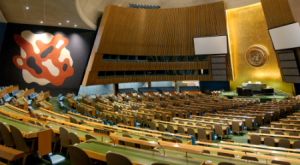
General Assembly (GA)The General Assembly is one of the six main organs of the United Nations, the only one in which all Member States have equal representation: one nation, one vote. All 193 Member States of the United Nations are represented in this unique forum to discuss and work together on a wide array of international issues covered by the UN Charter, such as development, peace and security, international law, etc. In September, all the Members meet in the General Assembly Hall in New York for the annual General Assembly session.

Our work falls under The following main committees of the GA:

1. Second Committee (Economic and Financial Committee)
2. Third Committee (Social, Humanitarian and Cultural Committee)


Displaying 1 - 12 of 202
2025

The report addresses how diverse contexts amplify the barriers faced by persons with disabilities, particularly those subjected to discrimination or whose rights are not upheld. It examines the situation of persons with disabilities and the status of implementation of the Convention on the Rights of Persons with Disabilities in four such contexts: (a) rural or remote areas; (b) migration and forced displacement; (c) the criminal justice system; and (d) institutional settings, and provides an overview of good practices taken to reduce the amplified barriers within these contexts, by States Parties and United Nations entities. 

The report includes recommendations to States Parties for the adoption of mainstreaming and targeted approaches, to create an inclusive environment at…

2025

As part of the preparations for and observance of the thirtieth anniversary of the International Year of the Family, the report is focused on the impact of climate change on the well-being of families, highlighting challenges relating to food and water scarcity, worsening physical and mental health, increased intrafamilial violence and child marriage. 

In the report, the Secretary-General focuses on the role of families in climate action, as food producers, educators, consumers and advocates, and elaborates on policy implications, including under updated nationally determined contributions. He also highlights good practices in family policymaking at the national and regional levels and describes the activities carried out in preparation for and observance of the anniversary…

2025

The report contains recommendations of concrete measures to advance the long-standing social commitments established in the Copenhagen Declaration on Social Development of 1995 and the Programme of Action of the World Summit for Social Development. Member States are called upon to: (a) close persistent gaps in access to essential services; (b) improve the quality of services; (c) invest in productive employment and decent work; (d) establish fair, effective and efficient tax systems; (e) promote transparent, inclusive and accountable governance; and (f) strengthen multilateral cooperation rooted in equity, economic security and solidarity.

2025

The report provides an overview of progress in implementing the resolution, focusing on the following emerging areas in youth development: (a) developing future-proof skills; (b) balancing opportunities and risks of artificial intelligence; and (c) fostering social resilience. It also reviews progress made in implementing the World Programme of Action for Youth, in the context of the thirtieth anniversary of the Programme. 

The report draws on input received from Member States, United Nations entities and youth organizations on efforts to advance youth development during the period under review. The report concludes with recommendations for consideration by the General Assembly.

2025

The report provides an update on progress made by the United Nations system in advancing disability inclusion and implementing the UN Disability Inclusion Strategy. Six years since its launch, the Strategy has helped integrate disability considerations into planning, strengthened leadership commitment, and promoted more inclusive programming. However, challenges remain in transforming organizational culture to be fully inclusive of persons with disabilities.

Drawing on progress reports from UN entities and country teams, the report reviews developments from 2019 to 2024, identifies barriers and enablers, and offers recommendations to strengthen coordination, implementation, and…

2025

The report contains an exploration of the central role of social capital as a transformative strategy for addressing multidimensional poverty and strengthening inclusive societies. Recognizing that poverty is both economic and relational in nature, the report serves to highlight how investments in trust, participation and social networks can reduce structural barriers, expand opportunities and foster a shared sense of belonging. 

In the report, national experiences are used to illustrate how social capital can be mobilized across key sectors, including employment, education, health, housing and community development, to address multidimensional poverty. The importance of inclusive governance, intergenerational solidarity and institutional trust as foundations for social…

2025

The present note contains the main findings of the World Social Report 2025: A New Policy Consensus to Accelerate Social Progress. Thirty years after the first World Summit for Social Development, the World Social Report 2025 warns of a mounting global social crisis marked by insecurity, inequality, and declining trust. While past decades have brought progress in poverty reduction and well-being, millions remain trapped in precarious livelihoods, informal work, and economic instability. Inequalities persist across income, gender, and generations, while climate change and rapid technological shifts deepen divides. Trust in institutions is eroding, social cohesion is weakening, and polarization is rising—undermining solidarity and the collective ability to meet the Sustainable…

2025

A/80/147 - Released on 5 August 2025 11:55 PM EDT: The report analyzes how commitments from the World Summit for Social Development align with current demographic realities as Member States prepare for the Second World Summit for Social Development (4–6 November 2025, Doha). It focuses on the three pillars of social development—poverty eradication, productive employment, and social integration—highlighting policy priorities such as strengthening care systems, adapting to technological change (including AI), preparing for climate-related shocks, combating age-based discrimination, promoting lifelong learning, fostering age-inclusive workforces, and enhancing community participation. Emphasizing the perspective of population ageing and the contributions of older persons, it also provides…

2025

The Special Rapporteur on the Rights of Indigenous Peoples is requested by the Human Rights Council to present two annual reports: one at its regular sessions in Geneva, usually held in September, and another at the General Assembly, typically in October. These annual reports include a description of the activities carried out during the year within the framework of the mandate and often include discussions on specific themes or issues of particular relevance to the rights of Indigenous Peoples.

These reports to the General Assembly can be accessed here.

2024

English | Français | Español | Русский | عربي | 汉

The report, submitted pursuant to General Assembly resolution 77/27, examines the contribution of sport to achieving peace and the Sustainable Development Goals. It describes progress towards implementation between 2022 and 2024 of the United Nations Action Plan on Sport for Development and Peace. Drawing on inputs from leading global experts, Member States, the United Nations system and other stakeholders, the report focusses on progress in five priority areas of impact: (i) social inclusion through sport, (ii) physical activity, physical education, and community-based participation in sport, (iii) gender equality in and through sport, (iv) peacebuilding and crime prevention, and (v) sustainable communities…

2024

The report provides updates on progress and concrete steps to implement the Sustainable Development Goals for persons with disabilities, highlights the impacts of the coronavirus disease (COVID-19), shares findings from the Disability and Development Report 2024 and recommends policies for implementing the goals of the 2030 Agenda for Sustainable Development. It emphasizes accessibility, economic opportunities, assistive technologies, data-informed policies and multisectoral collaboration. Upcoming summits aim to promote inclusive development, partnerships and international cooperation.

The report concludes with policy recommendations to accelerate progress on the 2030 Agenda for persons with disabilities. It calls for a comprehensive, inclusive approach to address policy gaps…

2024

The report presents an overview of existing digital divides and policy options to promote meaningful connectivity for all, in particular those living in poverty. It is then focused on how information and digital technologies are used by Governments to enhance the efficiency, effectiveness and inclusiveness of social policies, by drawing references from the fields of social protection, health care and education.

The report provides the following considerations and recommendations to ensure that the integration of information and digital technologies into social policies is guided by broader development objectives, favours inclusion and social equity, protects human rights and benefits all, while accelerating progress towards the achievement of the 2030 Agenda for Sustainable…